
Continuum: Full Lifecycle Traceability by Design
From requirements to build – every change is linked to requirements, validated, and automatically documented for auditable, data-driven development
Full Lifecycle Traceability in Continuum
Traceability in Continuum is based on the Doc-as-Code methodology, where documentation, source code, and engineering processes are integrated into a unified, version-controlled environment. Requirements, architecture, implementation references, test specifications, test results, releases, and status views are treated as engineering artifacts that can be committed, reviewed, validated, and released together with the software. This keeps documentation synchronized with development and makes traceability part of the normal engineering workflow, not a separate reporting activity.
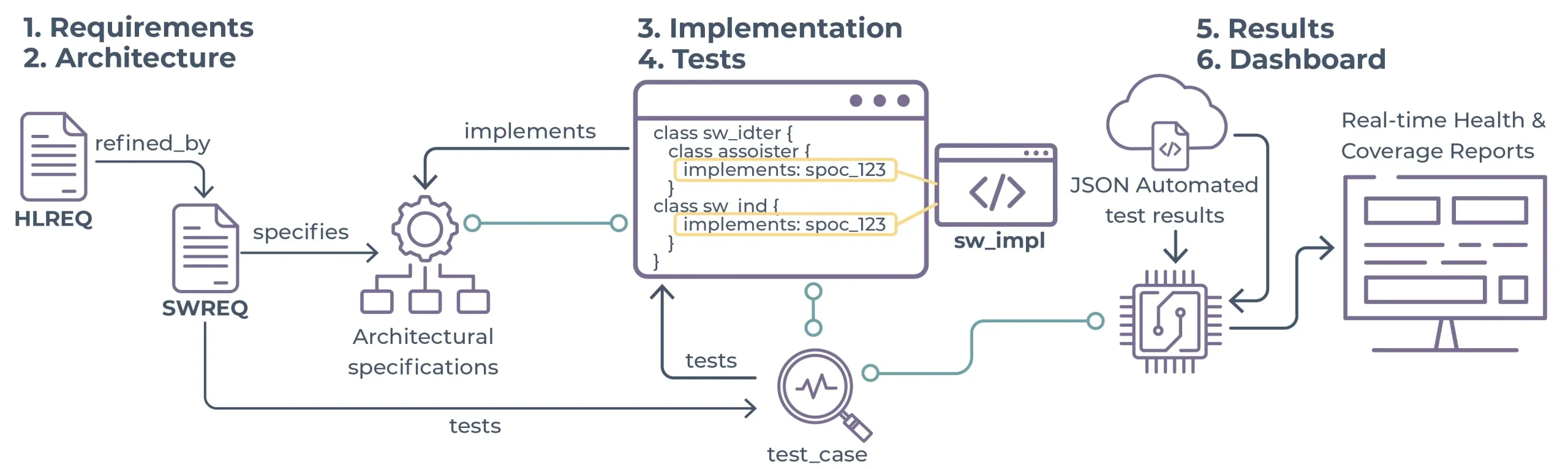
The Doc-as-Code model defines how these artifacts are structured and connected across repositories, elements, projects, and deployments. Requirements describe what must be achieved, architecture specifications describe how the requirement is fulfilled, software implementation items identify the source-code locations that realize the architecture, and tests provide verification evidence. In Continuum, this lifecycle chain is expressed as:
REQ → ARCH → CODE → TEST → RESULT
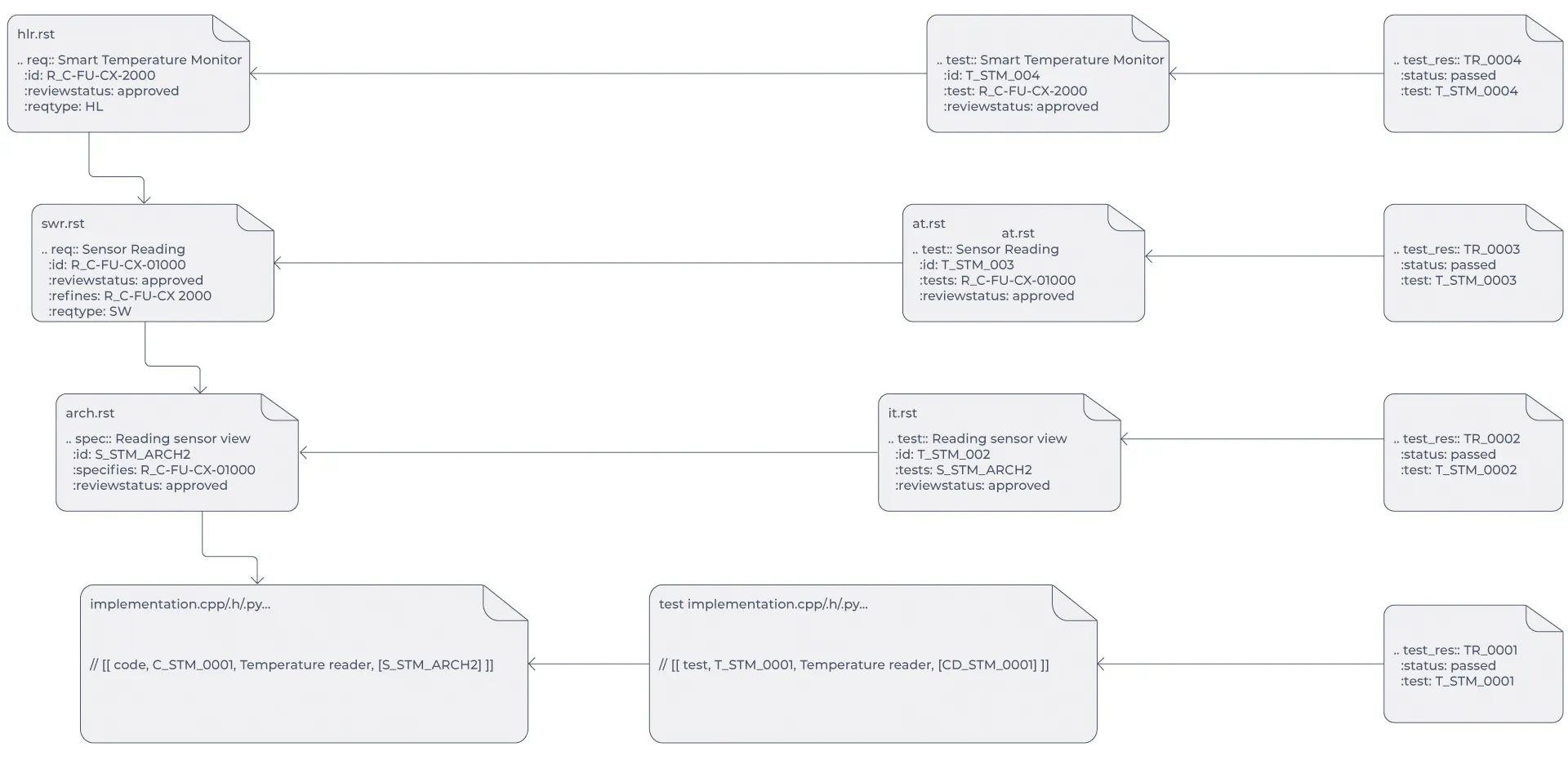
The model is implemented with Sphinx-Needs as the core traceability mechanism. Engineering objects such as req, spec, sw_impl, test_case, test, release, and platform are defined with unique IDs, metadata, review status, and explicit relation fields. These objects can then be filtered, visualized, validated, and aggregated into status overview pages and dashboards.
Why Traceability Is Needed
Traditional project setups often split requirements, architecture, tests, code, and reports across separate tools such as ALM systems, office documents, test tools, and CI servers. This creates fragmented data, manual synchronization effort, missing links between code and documentation, outdated documents, and limited visibility into project status. Continuum addresses this by treating documentation and engineering metadata as code: artifacts are stored in plain-text formats such as .rst, .puml, .json, and source-code annotations, then versioned and reviewed together with the implementation.
Traceability solves more than documentation completeness. It ensures engineering consistency. Every change can be explained through its lifecycle chain: the requirement that triggered it, the architecture that defines it, the code that implements it, the test that verifies it, and the latest result that confirms its status. This enables faster impact analysis, root-cause investigation, release readiness checks, and audit preparation directly from the traceability graph. Since artifacts are text-based and versioned with the software, CI pipelines can validate links, import results, generate reports, and publish dashboards from the same source of truth. This removes “black-box” development and enables transparent, auditable, data-driven engineering across the Continuum software factory.
Traceability Data Model
The Continuum traceability model is based on typed Sphinx-Needs objects. Each item has a unique ID, review status, type-specific metadata, and relation fields that connect it to other lifecycle artifacts.
Requirements define what the system or component must achieve. Architecture specifications define how the requirement is fulfilled. Software implementation items point to the exact source-code location that realizes an architectural specification. Test cases define how the artifact is verified, while test result objects capture the actual execution outcome imported from CI or external test-management systems.
Requirements
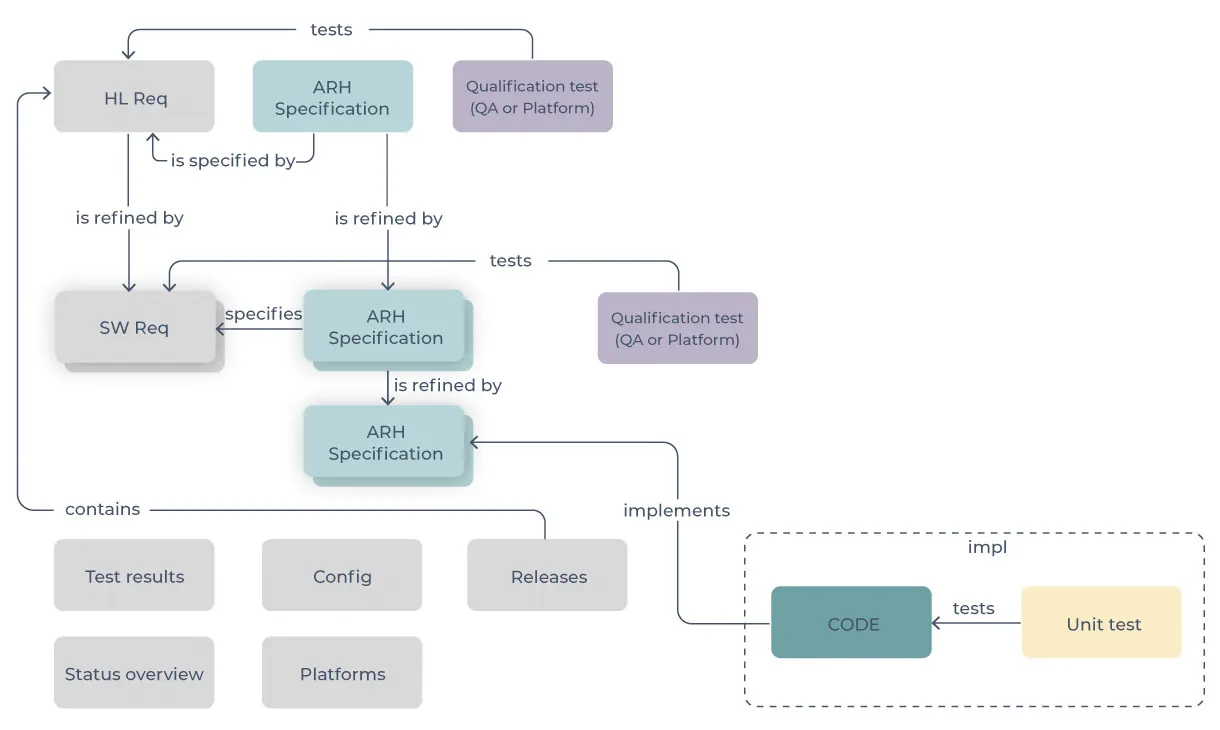
Requirements are the entry point of the traceability model. High-level requirements describe customer, system, or business-level behavior, while software requirements refine them into implementation-relevant, verifiable statements. Each software requirement must trace back to exactly one high-level requirement, and each requirement should describe a single testable behavior or constraint.
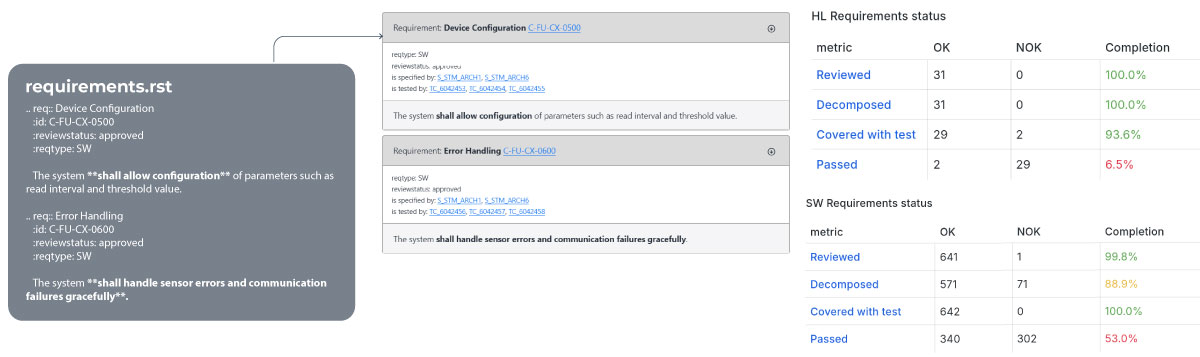
In practice, requirements are written as Sphinx-Needs req objects in .rst files. Their metadata includes a unique ID, review status, requirement type, refinement links, and body text. This enables automatic filtering, coverage analysis, review workflows, and generation of requirement overviews.
Architecture
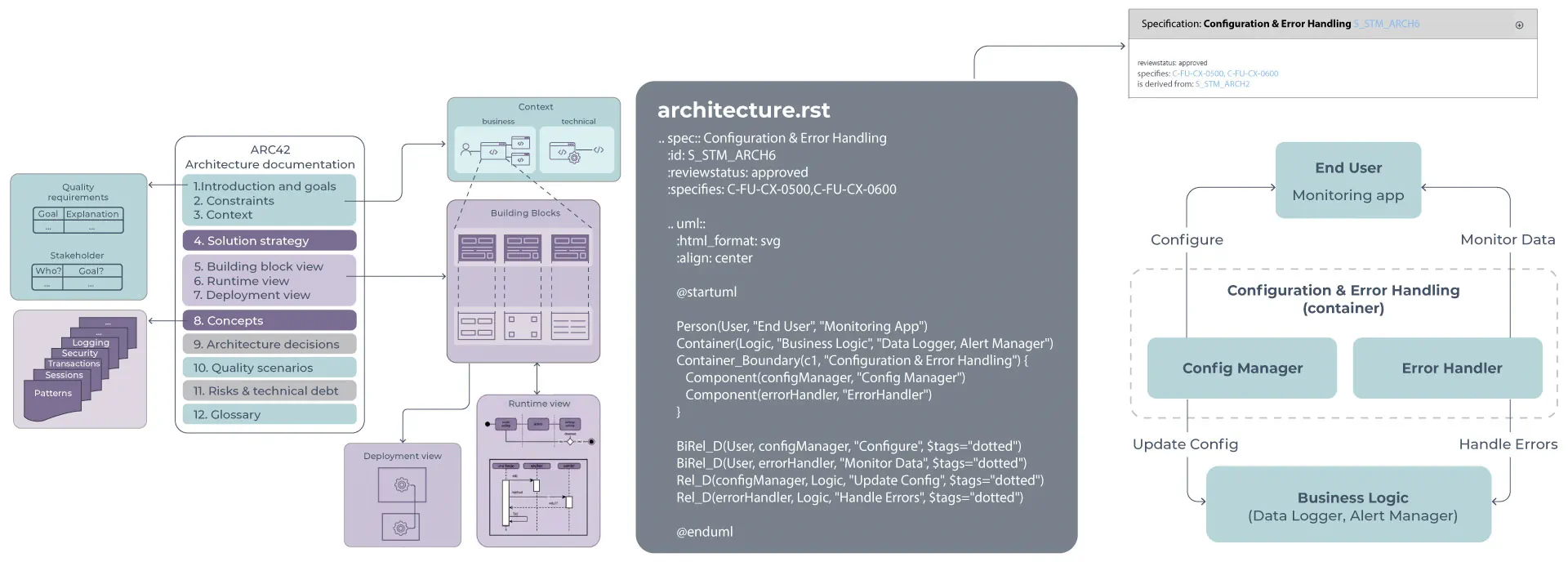
Architecture documentation explains how the software fulfills its requirements. In Continuum, each relevant architectural statement or diagram is represented as a spec object. Architecture items link upward to requirements using the specifies relation, while architecture refinement within the same decomposition level can be expressed using refines.
The architecture structure follows arc42 and is decomposed using the C4 model across system, container, component, and unit levels where needed. PlantUML is used for diagrams as code, which allows architecture diagrams to be versioned, reviewed, regenerated, and validated by CI.
The important rule is that architecture must remain requirements-driven. Lower-level design should not appear as an isolated diagram or document; it must be justified by requirements and connected to implementation and tests through the traceability graph.
Code
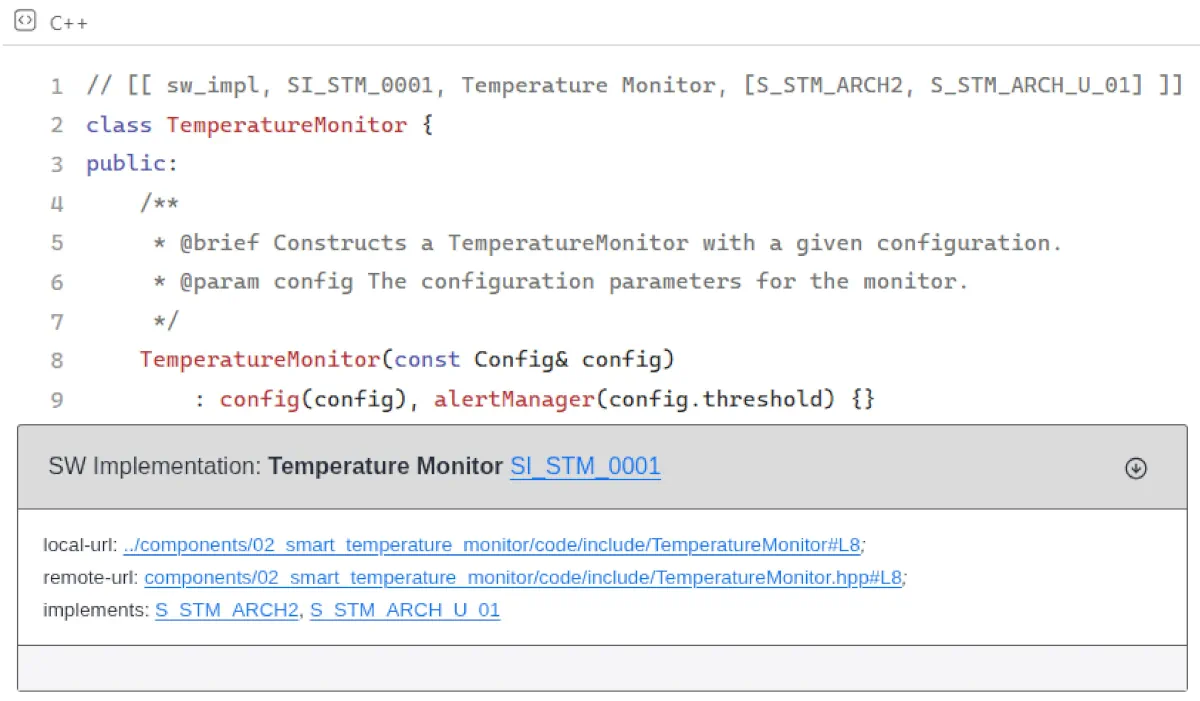
Software implementation traceability is established through sw_impl items. These are not manually maintained in documentation files. Instead, developers annotate the relevant source-code elements directly in code, for example above a function, class, module, configuration block, or file-level implementation. The tooling scans these annotations and generates Sphinx-Needs sw_impl objects automatically.
Each sw_impl item links upward to one or more architecture specifications using the implements field. The generated object also contains automatically resolved links to the exact local and remote source-code location, including file and line information. This keeps the documentation synchronized with the implementation and allows reviewers, auditors, and engineers to navigate from architecture to code and back.
Test and Test Results
Tests close the verification side of the traceability chain. In Continuum, test specifications are represented as test_case objects. Depending on the test level, they may link to requirements, architecture specifications, or software implementation items. Verification tests trace to requirements, component or integration tests may trace to architecture items, and unit tests trace to sw_impl items. A single test case must not mix different target artifact types in the same relation.
Executed test results are represented separately as test objects. They are not manually written in .rst files; they are imported automatically from CI systems, test frameworks, or external tools in JSON format. Each result links back to its corresponding test_case, allowing the documentation site and dashboards to show current verification status, coverage, and failed/passed evidence.
Automation and Continuous Validation
Traceability is only useful if it stays current. In Continuum, this is achieved through:
- Continuous synchronization - all lifecycle artifacts (requirements, architecture, code, tests, results) are continuously updated and validated together with the software, ensuring that traceability always reflects the current system state.
- Automated validation and quality gates - the CI/CD system validates documentation alongside code, detecting broken links, invalid diagrams, missing references, outdated artifacts, and inconsistencies before changes are merged. Each change or pull request is automatically gated by verifying that requirement and architecture updates remain consistent with code modifications (and vice versa).
- Traceability-driven change management and testing - The traceability graph enables precise change management by linking all impacted artifacts. Based on these links, test execution can be optimized to run only the tests relevant to the modified requirements, architecture, or implementation.
Reporting and Dashboards
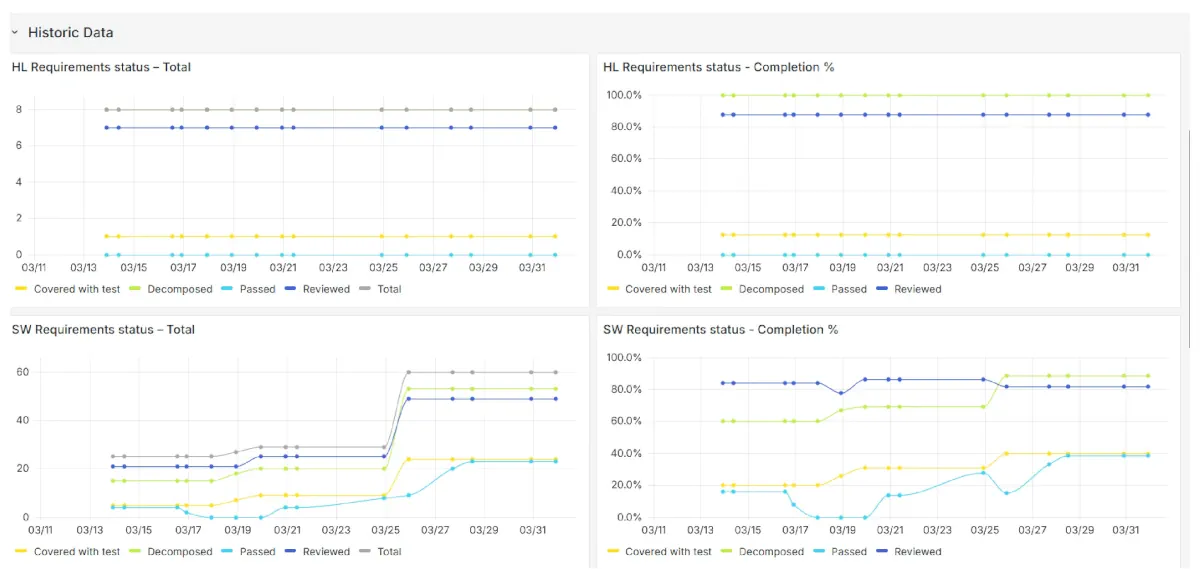
Having consistent, up-to-date traceability across all lifecycle artifacts enables fully automated, real-time project reporting. Dashboards are continuously generated from the traceability graph, ensuring that all metrics reflect the current system state. Traceability provides the structured, linked data between requirements, architecture, code, tests, and results, enabling project status and progress to be measured directly from engineering artifacts. Test coverage and pass/fail rates can be continuously derived and visualized at requirement, architecture, or implementation level, providing real-time insight into feature completeness, verification status, and overall system quality without manual reporting.
See the Dashboards page for details on structure, KPIs, and visualization capabilities.
Traceability Benefits
Traceability in Continuum enables:
- Change impact analysis by identifying affected architecture, implementation, tests, and release scope from a requirement change
- Root-cause identification by tracing a failure through requirements, architecture, code, tests, and execution results
- Reproducibility by allowing any released version to be reconstructed from a single, versioned Git state
- Live project reporting by deriving real-time dashboards and KPIs directly from traceability data
- Full auditability through a complete, linked evidence chain across the entire development lifecycle
- Compliance readiness for ASPICE and similar standards requiring consistent end-to-end traceability